5 Hidden Costs in AI Projects (and How to Budget Them)
Written by
Atomic Build Team
Reading time: ~7 min
You've got the green light for your AI project.
The API costs are clear. Developer hours are estimated. Leadership is excited.
Then reality hits: your "simple" chatbot project just doubled in price, and you're not sure where the money went.
Sound familiar? You're not alone.
Most AI budgets focus on the obvious expenses model usage, engineering time, cloud infrastructure while the real budget killers hide in plain sight.
These hidden costs can turn a $50K proof-of-concept into a $200K production nightmare.
Let's uncover the five hidden costs that derail AI projects and, more importantly, how to estimate them before they blow up your budget.
What You'll Learn
- The 5 hidden costs that make AI project budgets double
- How to estimate data preparation (cleaning, integration, labeling) using a 2–3x multiplier
- What to budget for experimentation and fine-tuning (15–50 iterations) and API testing costs
- The real cost of production infrastructure and scaling (integrations, monitoring, reliability)
- How to plan for maintenance and model drift (about 40–60% per year of the initial build cost)
- How to include compliance, security, and legal (GDPR/CCPA) plus a 20–30% contingency buffer
Quick Start: Use the AI Cost Calculator to model your scenario in 2 minutes and see how these hidden costs affect your total budget.
Try the AI Cost Calculator
1. Data Preparation Costs: The 80% Budget Rule
What it is:
The unglamorous work of collecting, cleaning, labeling, formatting, integrating, and validating data before your AI can use it.
Why it’s hidden:
Teams assume their existing data is “AI-ready.” In reality, data is usually spread across systems, inconsistent, and full of missing/dirty fields so data prep quietly becomes the main project.
Real example:
In CrowdFlower’s 2016 Data Scientist Report, respondents reported spending the majority of their day on data work before modeling:
- 60% of time: cleaning and organizing data
- 19% of time: collecting data sets
How to estimate:
- Basic cleanup: 20–40 hours per data source
- Complex integration: 80–200 hours for multiple legacy systems
- Labeling: $0.50–$5 per data point for human annotation (if needed)
Rule of thumb:
Budget 2–3× your initial data prep estimate, because the “unknown unknowns” (missing IDs, inconsistent schemas, duplicates, edge cases) show up only after you start pulling data.
2. Model Training and API Costs During Fine-Tuning
What it is:
The iterative process of testing models, adjusting prompts or parameters, running evaluations, and repeating this cycle until the system is reliable enough for production.
Why it’s hidden:
Early demos rely on off-the-shelf models that appear to work. Production exposes edge cases, hallucinations, and safety issues that require many rounds of iteration, each with real API and compute costs.
Real example:
In 2023, researchers at Stanford released Alpaca, a fine-tuned instruction-following model based on Meta’s LLaMA. While often cited as “cheap to build,” the project documentation clearly shows that iteration and experimentation were unavoidable costs.
Key facts from the official Stanford release:
- The team generated 52,000 instruction-response examples
- Data generation required multiple prompt iterations and filtering passes
- They reported ~$600 in API costs just for dataset generation
- Fine-tuning and evaluation required additional compute and repeated testing cycles
While Alpaca was a research project, the Stanford team explicitly notes that prompt quality, filtering, and repeated experimentation were the hardest and most time-consuming parts, not the base model itself.
How to estimate:
- Experiment cycles: 15–50 iterations
- Compute / API cost per cycle: $50–$500
- Evaluation & testing: $500–$5,000/month during experimentation
Rule of thumb:
Reserve 25–35% of your technical budget for iteration and fine-tuning, even when using “ready-made” models.
3. Infrastructure and Scaling Costs for Production AI
What it is:
The work required to move an AI model from a demo into a reliable production system: integrating with existing software, setting up monitoring and logging, adding security and authentication, building fallback mechanisms, and ensuring the system can scale with real user traffic.
Why it’s hidden:
AI demos run in notebooks or isolated services.
Production systems must meet uptime guarantees, latency targets, and security requirements and must integrate with legacy systems that were never designed for AI.
Real example:
Uber’s Michelangelo machine learning platform shows how infrastructure and integration quickly outweigh model development.
Uber built Michelangelo to deploy ML models for routing, ETA prediction, pricing, and fraud detection.
While the models themselves worked early on, Uber engineers found that most of the effort went into building production infrastructure, including data pipelines, model serving systems, monitoring, rollback mechanisms, and high-availability deployments.
How to estimate:
- API integration: 40–100 hours per system
- Monitoring & observability: 20–60 hours (e.g., Datadog, Prometheus)
- Production infrastructure: $200–$2,000 per month
- Scaling & redundancy: add 30–50% overhead
Rule of thumb:
Expect integration and production hardening to take 1.5–2× longer than building the AI model itself.
4. Ongoing Maintenance Costs and Model Drift
What it is:
The ongoing engineering work required to keep AI models accurate and reliable after launch.
This includes monitoring model performance, retraining models as data changes, fixing failures, updating dependencies, and managing model versions in production.
Why it’s hidden:
Most AI budgets focus on building and launching a system.
Very few account for the 12–24 months of continuous work after deployment, even though real-world data changes constantly and models degrade without maintenance.
Real example:
Netflix’s recommendation systems require continuous monitoring and retraining to remain effective as user behavior and content catalogs change.
Netflix engineers explain that models must be regularly retrained on fresh data to prevent performance degradation and ensure recommendations stay relevant.
How to estimate:
- Performance monitoring: 10–20 hours per month
- Regular retraining: 40–80 hours per quarter + compute costs
- Bug fixes and updates: 15–30 hours per month
- Model versioning and rollback: 5–10 hours per month
Rule of thumb:
Annual AI maintenance costs typically equal 40–60% of the initial build cost.
5. Compliance, Security, and Legal Costs for AI Systems
What it is:
The work required to ensure AI systems comply with data protection laws (such as GDPR and anti-discrimination regulations), pass legal and security reviews, support auditability, and avoid regulatory or reputational risk. This often includes consent handling, data retention controls, bias testing, explainability, and formal legal review.
Why it’s hidden:
Compliance and legal teams are frequently brought in after AI systems are already built. When compliance gaps are discovered late, teams are forced to retrofit privacy, fairness, and transparency into systems that weren’t designed for it, dramatically increasing cost and delivery time.
Real example:
Amazon’s AI recruiting tool is a well-known case of compliance and legal risk emerging after development.
Amazon built an internal AI system to screen job candidates.
After deployment, the company discovered the model was biased against female candidates, raising serious legal and compliance concerns related to employment discrimination laws.
As a result, Amazon ultimately abandoned the system entirely after failing to fully mitigate the bias.
The issue wasn’t model performance, it was regulatory and legal risk once bias was identified.
How to estimate:
- Security and compliance audits: $5,000–$25,000 (one-time)
- Legal review and risk assessment: $3,000–$15,000
- Compliance implementation (GDPR, audit logs, explainability): 60–150 engineering hours
- Bias and fairness testing: $2,000–$10,000
- Ongoing compliance maintenance: $1,000–$5,000 per year
Rule of thumb:
In regulated domains (HR, finance, healthcare), add 15–20% to the total AI project budget for compliance, security, and legal costs.
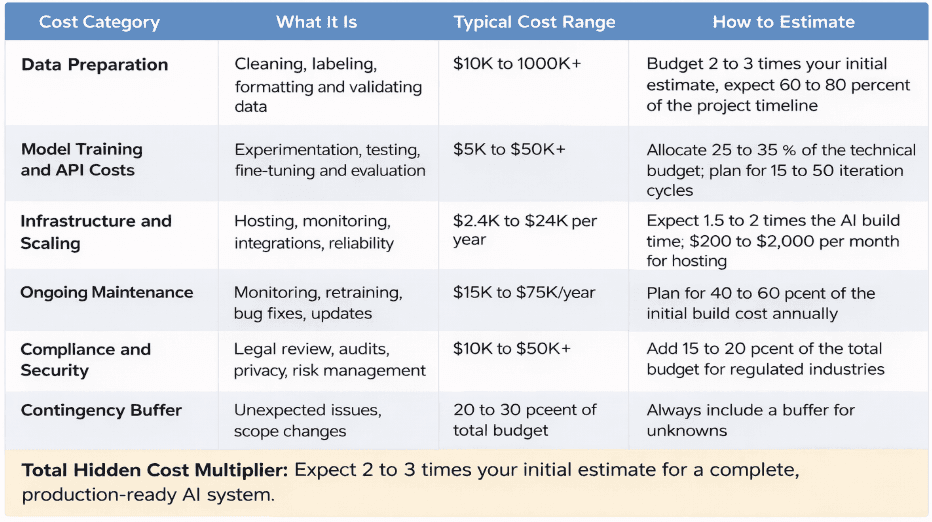
AI Project Cost Breakdown: Hidden Expenses Table
This table shows the true cost structure of AI projects. Use it to calculate your realistic budget:
Launch Interactive Calculator
See your real AI budget in under 2 minutes
Quick Estimation Rules
- The 3x Rule: Whatever your initial AI project estimate, multiply by 3 for the true all-in cost.
- The 80/20 Data Rule: Assume 80% of your time goes to data, 20% to modeling (at least initially).
- The Integration Tax: Double your timeline once you need to integrate with existing systems.
- The Annual Maintenance Fee: Budget 50% of Year 1 costs for Year 2 ongoing maintenance.
- The Compliance Multiplier: In regulated industries (healthcare, finance, HR), add 20% to your total budget for legal and compliance.
Final Checklist: Before You Lock Your Budget
- Use this checklist to ensure you've accounted for all hidden costs:
- Have you budgeted 2-3x your initial data preparation estimate?
- Have you reserved 25-35% of your technical budget for experimentation?
- Have you estimated integration at 1.5-2x the time to build the AI?
- Have you included 12-24 months of maintenance costs?
- Have you factored in compliance, security, and legal reviews?
- Have you added a 20-30% contingency buffer for unknowns?
- Have you estimated token usage and API call volumes for production?
- Have you planned for scaling infrastructure as usage grows?
Get Your Accurate Budget in 2 Minutes
Estimating AI costs doesn't have to be guesswork.
Use the AI Cost Calculator to model your specific project input your requirements and get instant estimates for:
- Data preparation and cleaning
- Model training and API costs
- Infrastructure and scaling expenses
- Ongoing maintenance projections
- Compliance and security requirements
Try the AI Cost Calculator
The Bottom Line
Hidden costs aren't just line items, they're the difference between an AI project that ships on time and one that drains resources for months.
Budget for the invisible work, and you'll avoid the painful conversations about why everything costs twice as much as promised.